Anthracite Coal - Deep Mining
Most coal seams are too deep underground for opencast mining and require underground mining, which method currently accounts for about 60% of world coal production.In deep mining, the room and pillar or bord and pillar method progresses along the seam, while pillars and timber are left standing to support the mine roof. Once room and pillar mines have been developed to a stopping point (limited by geology, ventilation, or economics), a supplementary version of room and pillar mining, termed second mining or retreat mining, is commonly started. Miners remove the coal in the pillars, thereby recovering as much coal from the coal seam as possible. A work area involved in pillar extraction is called a pillar section. Modern pillar sections use remote-controlled equipment, including large hydraulic mobile roof-supports, which can prevent cave-ins until the miners and their equipment have left a work area. The mobile roof supports are similar to a large dining-room table, but with hydraulic jacks for legs. After the large pillars of coal have been mined away, the mobile roof support's legs shorten and it is withdrawn to a safe area. The mine roof typically collapses once the mobile roof supports leave an area.
There are five principal methods of underground mining:
Longwall mining accounts for about 50% of underground production. The longwall shearer has a face of 1,000 feet (300 m) or more. It is a sophisticated machine with a rotating drum that moves mechanically back and forth across a wide coal seam. The loosened coal falls on to a pan line that takes the coal to the conveyor belt for removal from the work area. Longwall systems have their own hydraulic roof supports which advance with the machine as mining progresses. As the longwall mining equipment moves forward, overlying rock that is no longer supported by coal is allowed to fall behind the operation in a controlled manner. The supports make possible high levels of production and safety. Sensors detect how much coal remains in the seam while robotic controls enhance efficiency. Longwall systems allow a 60-to-100% coal recovery rate when surrounding geology allows their use. Once the coal is removed, usually 75 percent of the section, the roof is allowed to collapse in a safe manner.
Continuous mining utilizes a machine with a large rotating steel drum equipped with tungsten carbide teeth that scrape coal from the seam. Operating in a “room and pillar” (also known as “bord and pillar”) system—where the mine is divided into a series of 20-to-30 foot “rooms” or work areas cut into the coalbed—it can mine as much as five tons of coal a minute, more than a non-mechanised miner of the 1920s would produce in an entire day. Continuous miners account for about 45% of underground coal production. Conveyors transport the removed coal from the seam. Remote-controlled continuous miners are used to work in a variety of difficult seams and conditions, and robotic versions controlled by computers are becoming increasingly common.
Blast mining or conventional mining, is an older practice that uses explosives such as dynamite to break up the coal seam, after which the coal is gathered and loaded on to shuttle cars or conveyors for removal to a central loading area. This process consists of a series of operations that begins with “cutting” the coalbed so it will break easily when blasted with explosives. This type of mining accounts for less than 5% of total underground production in the U.S. today.
Shortwall mining, a method currently accounting for less than 1% of deep coal production, involves the use of a continuous mining machine with movable roof supports, similar to longwall. The continuous miner shears coal panels 150-200 feet wide and more than a half-mile long, having regard to factors such as geological strata.
Retreat mining is a method in which the pillars or coal ribs used to hold up the mine roof are extracted; allowing the mine roof to collapse as the mining works back towards the entrance. This is one of the most dangerous forms of mining owing to imperfect predictability of when the ceiling will collapse and possibly crush or trap workers in the mine.
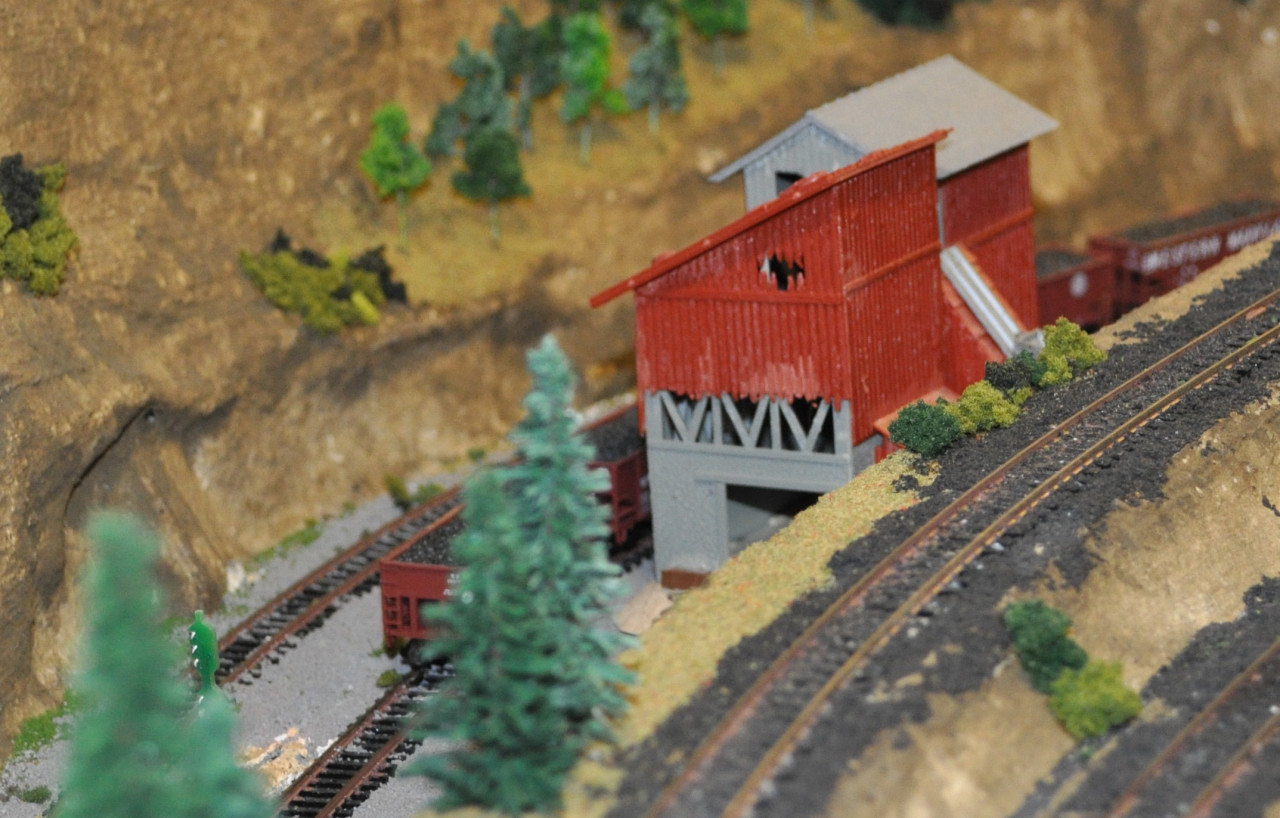
We model a deep coal mine near Sunbury, PA. Coal produced by this mine is exported via the Philadelphia port. A unit train regularly delivers this coal to the port. Occasionally coal is delivered to the Electric Generation Plant in Titusville.
Photo of Sunbury Coal Plant loading coal cars:
We also model a deep mine and colliery in Girardville.
Photo of Bulk Coal ship at Delaware River Port: